

Cathedral Curtea de Arges Facts and History
In 1515, Prince Neagoe Basarab, voivode of Principality of Walachia, commissioned a church, like no other. To to make his wish a reality, he invited to Curtea de Argeș, then the capital of Walachia, the most skilled architect in the Ottoman Empire: Manoli of Niaesia. Manoli (Manole) was a brilliant Armenian who had built several mosques in Constantinople / Istanbul. Prince Basarab never anticipated that, for a short time, Curtea de Argeș will become the center of European architectural innovation.
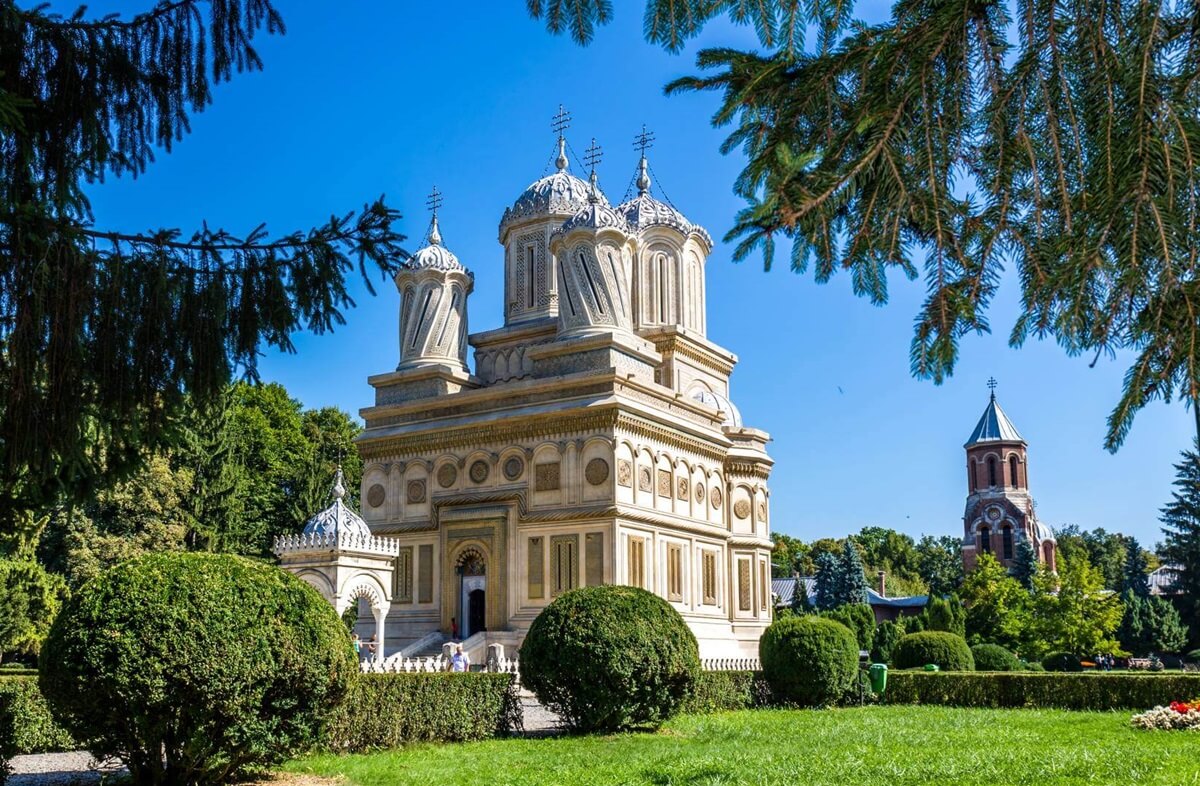
Written records attribute the concept of the building to the Prince Neagoe Basarab himself. During his youth, the prince allegedly spent time in Constantinople and became familiar with Middle Eastern architecture. Prince Neagoe Basarab, with Manoli and his team, created the first hybrid religious architecture style in Europe: a Byzantine in layout with Armenian, Georgian, and Ottoman decorations. It was something entirely new, unseen in the known world, a true architectural revolution. The original architecture of cathedral Curtea de Arges inspired for centuries that of many other places or worship, but none came even close to it.
The construction of the cathedral was completed in record time – just three years.
The Patriarch of Constantinople, Teolipt, was present at the consecration ceremony on August 15, 1517.
Other important figures present at the ceremony included the Mount Athos Holy Community (council)
and the entire clergy of Wallachia.
The fact that for the first time, in history, a Patriarch of Constantinople set foot on Romanian soil
was a confirmation of the unity of Orthodoxy in a way that had never been seen before.
The church became a Bishopric Cathedral in 1793, part of a large monastic ensemble.
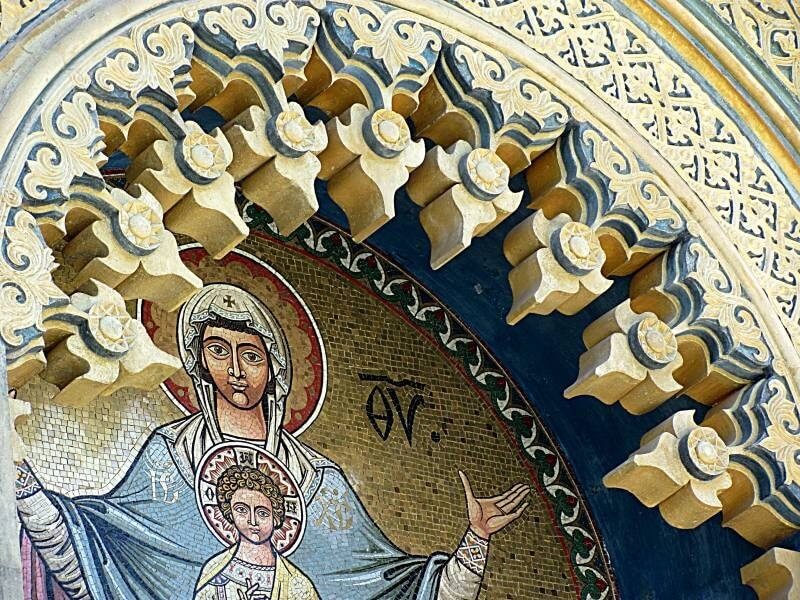
The unique architecture of cathedral Curtea de Argeș illustrates the inter-related artistic space that stretched from Eastern Europe and the Ottoman Empire to Russia, the Caucasus and beyond to Central Asia.
Curtea de Arges cathedral architecture and decorations have drawn admiration since the earliest chronicles and traveler accounts.
In 1654, Paul, the Archdeacon of Aleppo (Paul of Aleppo) - an Ottoman Syrian Orthodox clergyman and chronicler -
wrote that the cathedral was "one of the wonders of the world."
Words of high praise were also written, in 1794, by Sir Robert Ainslie, the British ambassador to the Porte (1776-1794),
and later, by French painter and illustrator Louis Bouquet (of the most brilliant French decorators in the inter-war period) and,
French lithographer, engraver and illustrator Dieudonné Auguste Lancelot (1860).
Their travel notes and prints spread the fame of the cathedral beyond the borders of Romania.
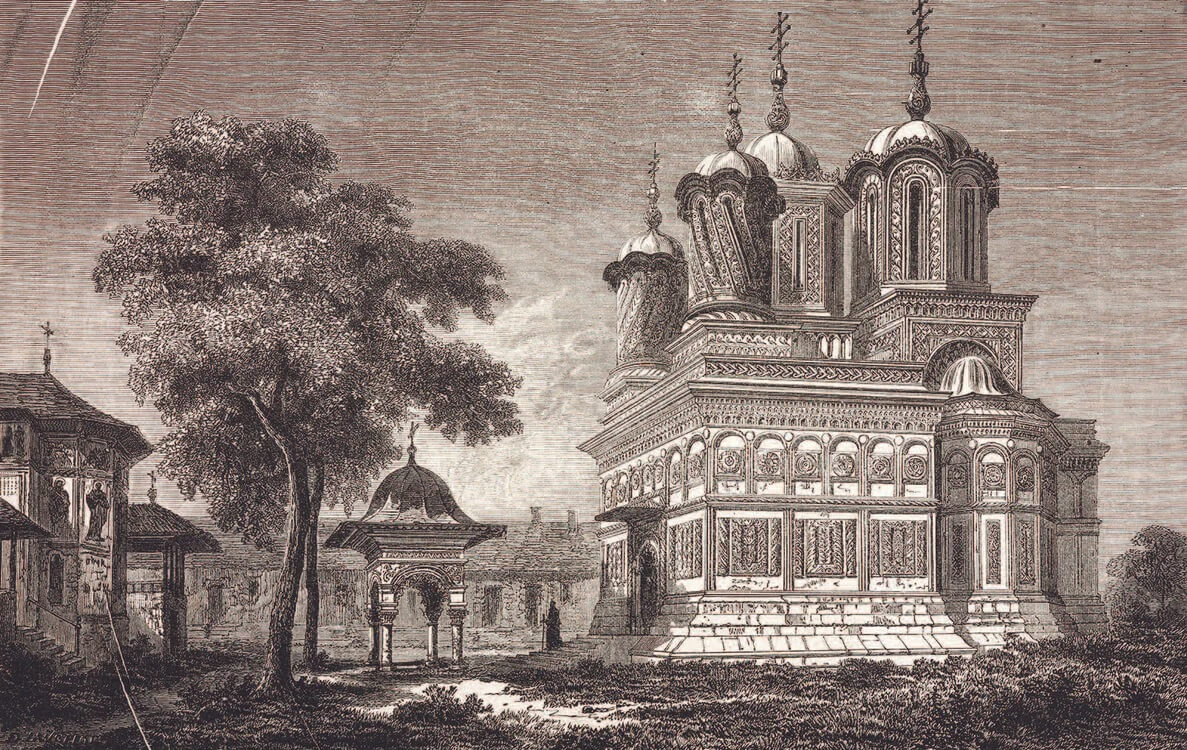 Curtea de Arges monastery, 1860 litography by Dieudonné Auguste Lancelot, photo © Wikimedia Commons
In 1867, at Paris Universal Exhibition, the cathedral Curtea de Arges stood as one of the most representative landmarks of Romania and a symbol of the new Romanian state. The church represented one of the main references of Romanian religious architecture: in 1878, it was called “the main title of glory of the Romanian arts of the past”.
A lavish restoration of the cathedral Curtea de Argeș was commissioned by King Carol I in 1875 when the king asked French architect André Lecomte du Noüy to recondition the cathedral. Works supervised by du Noüy included changes to the interior structure and the replacement of the original fresco with vividly-colored neo-Byzantine ones. A grand Episcopal Palace was constructed 200 feet away from the cathedral.
Shortly after the completion of the restoration works, in 1886, King Carol I designated the Cathedral of Curtea de Argeș cathedral as the royal necropolis.
The Exterior
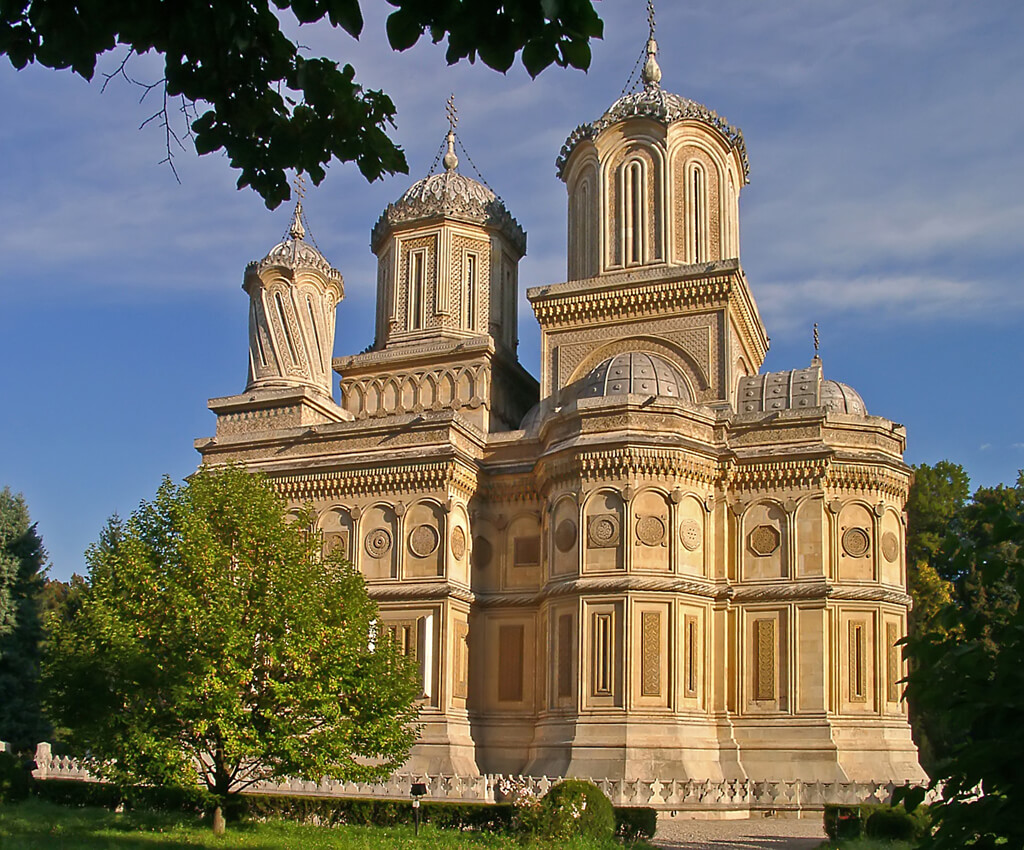
The 59-feet long, 33-feet wide and 82-feet high, cathedral in Curtea de Arges was one of the most impressive constructions of its time.
The beige limestone facades are decorated with flat reliefs featuring Caucasian and Islamic motifs.
A richly-carved middle cordon (brâu in Romanian) surrounds the façade and splits it into a lower and an upper sections.
The lower part displays narrow windows with richly decorated stone frames,
interrupted by either white or decorated marble slabs.
The upper part is marked by a row of blind arcades (contiguous arches), each containing a large decorative stone disc.
Another row of smaller decorative discs is displayed where the arches meet.
Each disc features an unique decorative motif.
The upper part of each small disc features a bronze bird which holds a small bell in its beak.
The birds on the facade were not just decorative.
According to a medieval chronicler, the wind made the birds whistle and the small bells beneath them chime,
creating a unique atmosphere around the building.
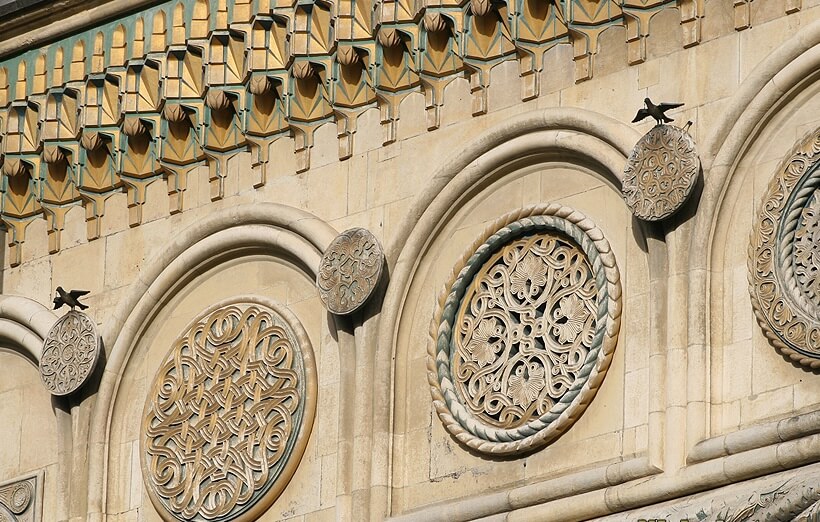
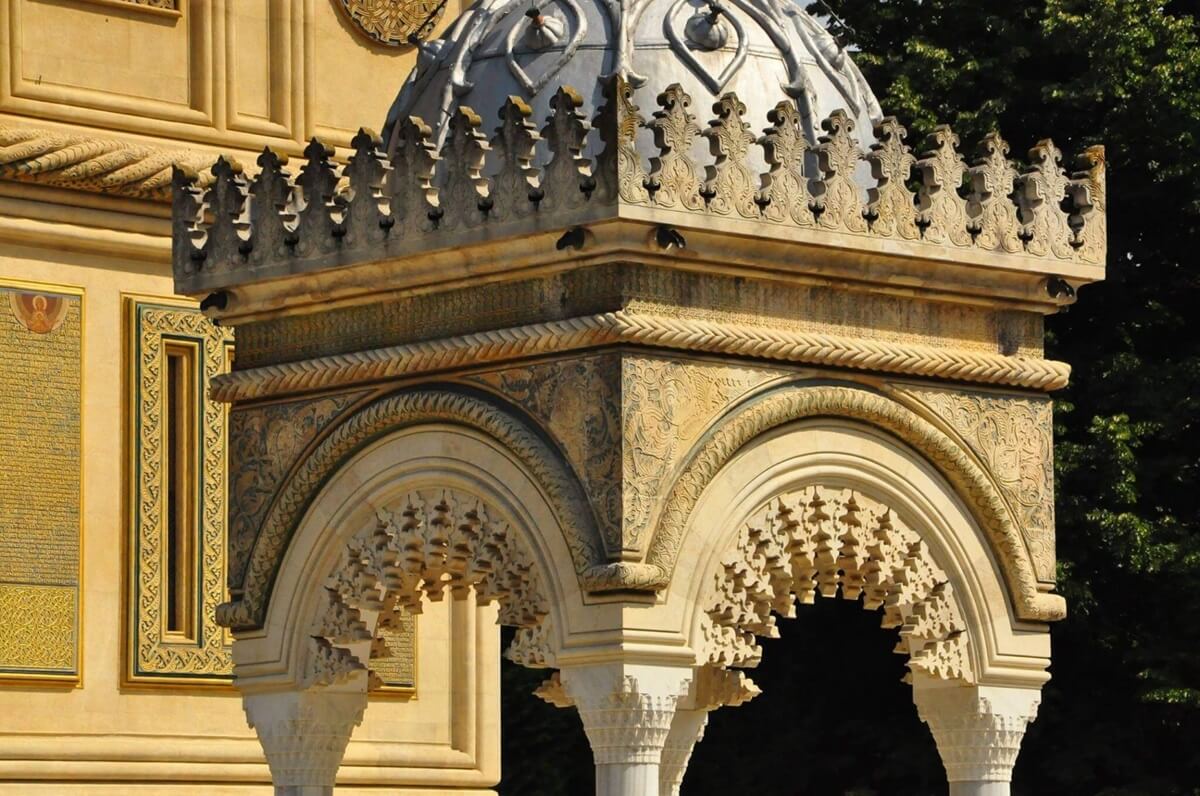
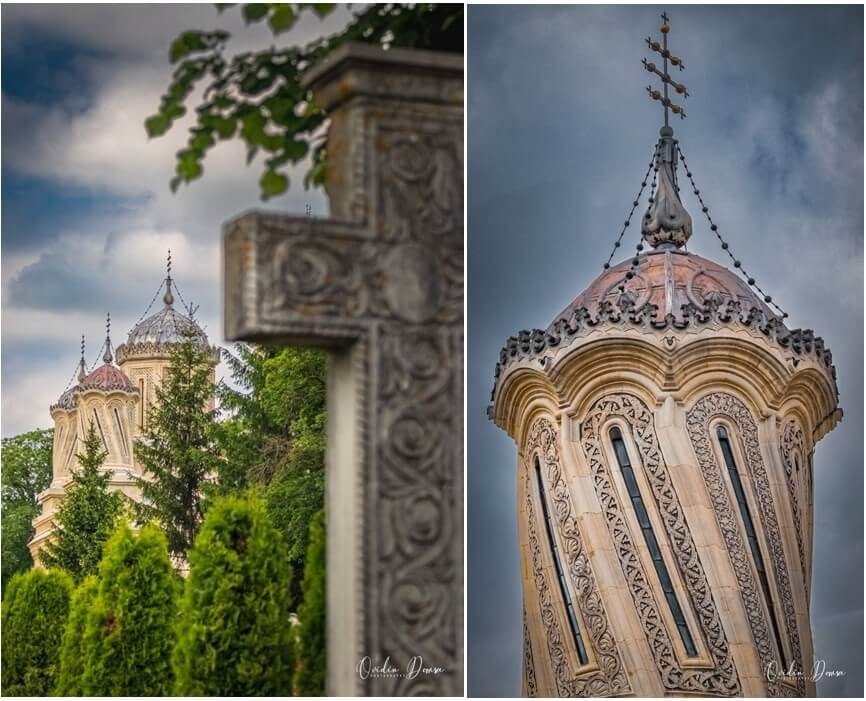
The cornice of the roof is marked by muqarnas-type ornaments, which are the beginning of extremely rich stone carvings, that cover the entire upper part of the church, including the roof and the four towers. The church's structure rises in a series of volumes and surfaces, on which the four towers stand. The towers display the richest decorations, especially along the very thin windows, and culminating with the curved windows and window frames of the smaller towers that give them the unique, twisting impression. The rare ornamental richness, like lace in relief, include a number of elements of Arabic and Georgian art skilfully harmonized. (Attribution: Princeton.edu)
The Interior
The interior of the cathedral is adorned with oil frescoes by painters
Emile-Frédéric Nicolle (French),
Charles Paul Renouard (French),
and Nicolae Constantinescu (Romanian, born in Curtea de Argeș).
Other decorative elements that draw attention and are considered exceptional sculptural achievements
include the votive panels, the altar made of marble, gilded bronze, and onyx,
the mosaic icons and the group of 12 columns representing the 12 Holy Apostles.
Each column, originally decorated with floral motifs, is carved from a single block of marble.
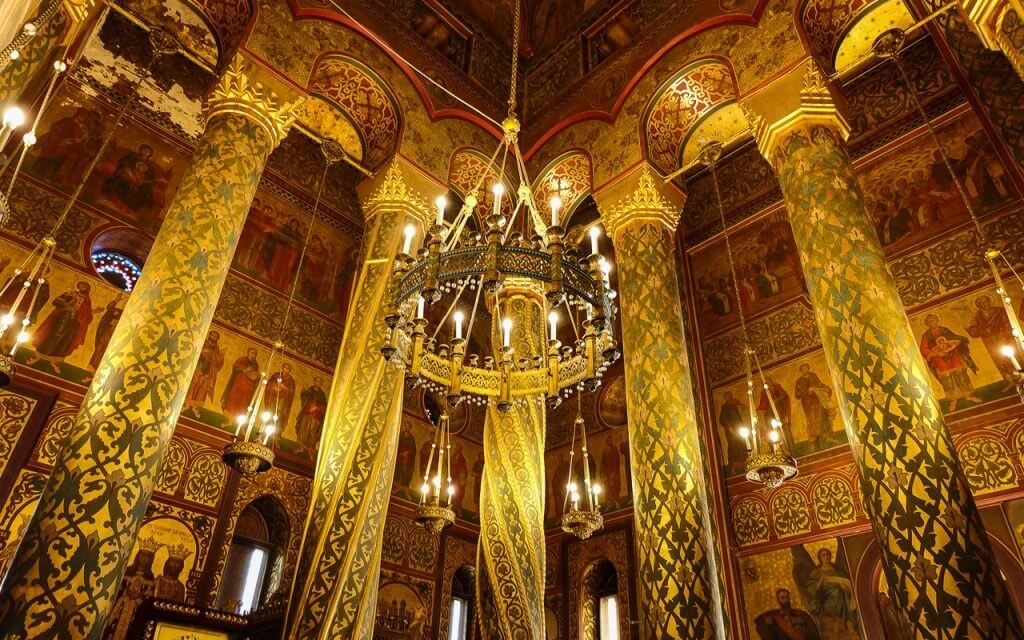
The nave is surrounded by three apses, the central one serving as the altar, and bearing the eastern tower, the highest, in the middle. Unusual for an Orthodox church, the narthex is larger than the nave. It is square-shaped and another smaller square is formed in the middle by twelve columns that support a second central tower and two smaller and twisting western towers.
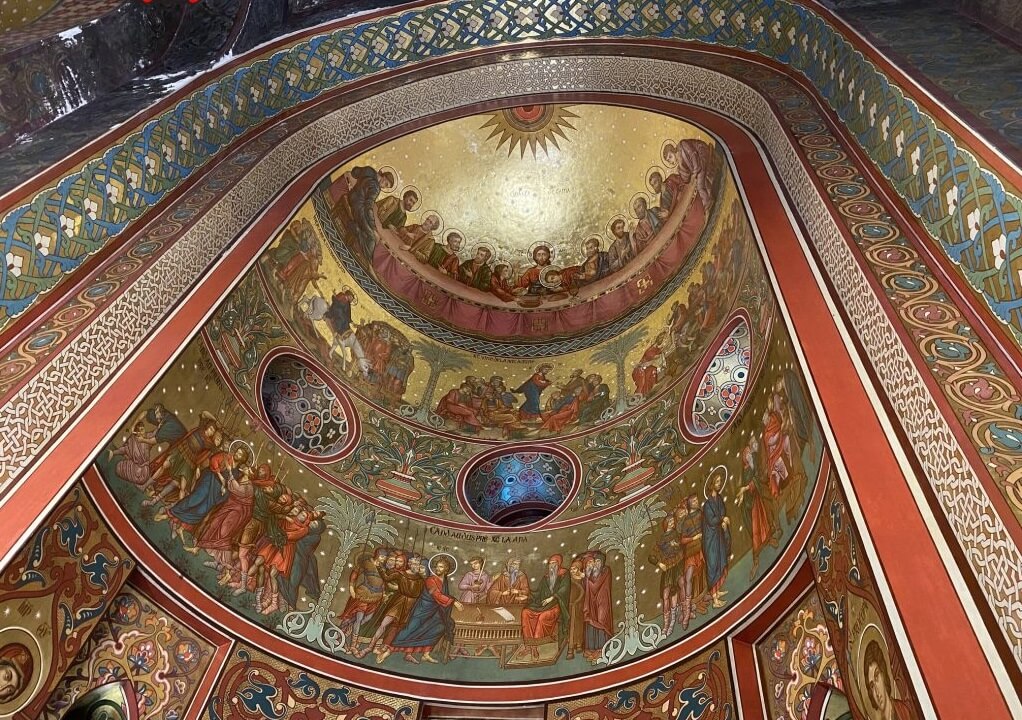
The enlarged narthex was designed to host princely graves, namely that of Neagoe Basarab, his immediate family members and successors. But it was most probably also the setting for an original religious scenography, with chairs and double-sided icons (four of them still existing) placed between the twelve columns.
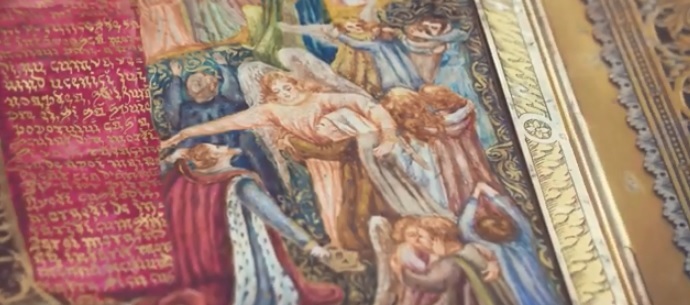
It contains the twelve Gospels read on Maundy Thursday, as well as the Gospel of the Resurrection from Holy Saturday. The large and richly decorated Codex was painted on parchment and written in gold and silver letters by Queen Elisabeth of Romania, herself.
...
Cathedral Curtea de Arges Legends
Cathedral Curtea de Arges is the setting of two captivating legends:
~ The creation of the outstanding Byzantine structure (Legenda Mănăstirii Argeșului),
developing the theme of the sacrifice for art
and
~ The ill-fated destiny of Grandmaster Manoli (Legenda Meșterului Manole),
a variation of the Icarus myth.
Legend of creation of Curtea de Arges Cathedral
Everything Manole and his team built during the day fell apart during the night.
No matter how much they tried they couldn't go ahead with construction.
One night Manole dreamed that the only way that he could complete the cathedral was with a human sacrifice.
Specifically, the first woman to appear the next morning must be immured within the cathedral walls to appease unknown forces.
Manole told his masons about his dream, and they all agreed to act according to the Grandmaster’s dream.
Since the site for the cathedral was remote, the only people coming by were the workers’ family.
Shortly after Manole and his team agreed to sacrifice the first woman who came to the construction site,
Manole looked over the hills and caught glimpse of his pregnant wife, Ana, coming to bring him lunch.
He prayed to God to start a strong storm that would make her to return home.
But Ana’s determination to bring food to her beloved husband kept her going.
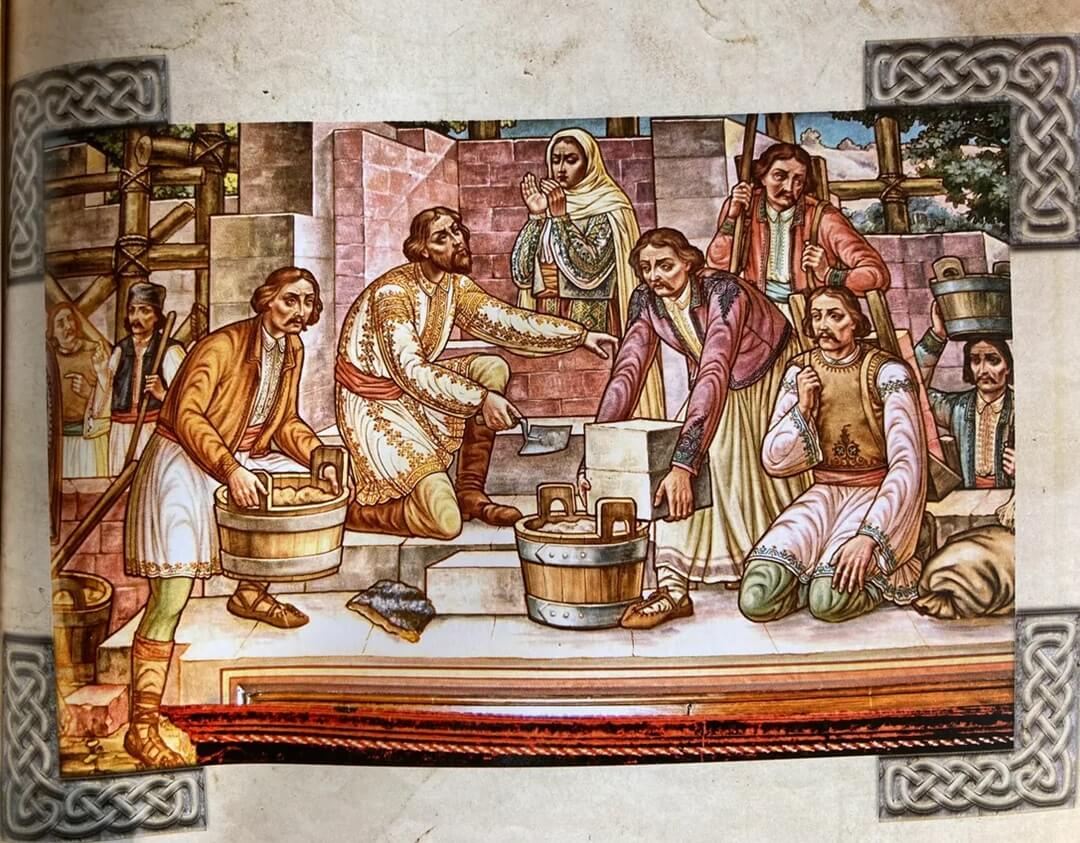
Manole kept praying but neither the strong wind nor the torrential rain could stop Ana to reach the construction site.
When she arrived, Manole and the other builders told her that they wanted to play a little game,
which involved building walls around her body.
She accepted but soon she became uncomfortable and implored Manole to stop.
Although Ana begged for her life and her unborn child but Manole kept walling his wife brick by brick.
With his heart broken and tears in his eyes, and,
without saying one word, Manole immured his wife into the southern wall of the cathedral.
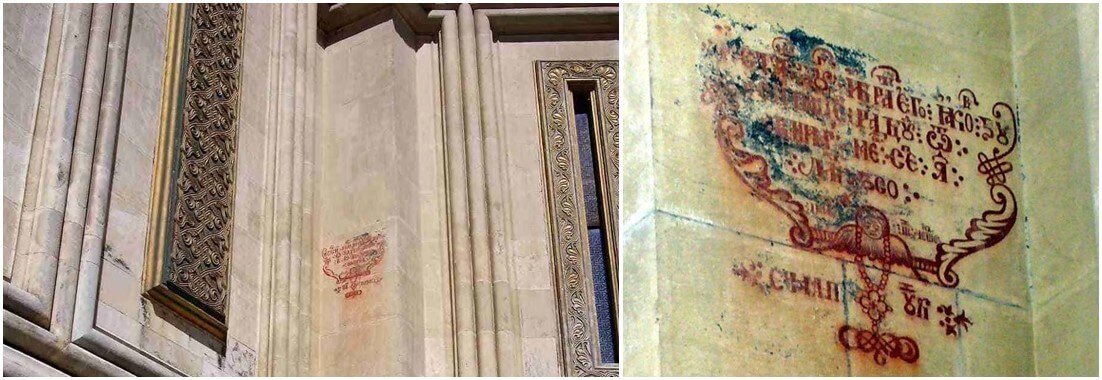
A red mark on the cathedral's souther wall marks the place where Manole's wife's was immured, in the edifice.
...
The ill-fated end of Grandmaster Manoli
Another legend speaks of Manole’s end, caused by jealousy.
When the cathedral was almost completed, and Manole and his craftsmen were doing roof's finishing touch,
prince Neagoe Basarab asked Grandmaster Manoli if he could build an even more beautiful church.
Manole answered he could.
Because the prince wanted to make sure that nothing to match his stunning cathedral would ever be replicated,
he ordered his men to remove the scaffolds and Manoli and his team were left stranded on the roof.
With no means to get off the roof, Manoli and his men decided to use wood shingles
to make bird-like wings and get to the ground.
However, their attempt failed, and all the craftsmen died when reaching the ground.
The legend also says that, miraculously,
a water spring appeared on the very spot where Manoli supposedly landed and died.
The spring (Fantana lui Manole) is located 690 feet west of the entrance to the cathedral,
in a small park called Manole's Spring.
Thirsty locals and visitors can drink water straight from the spring.
...
Plan your visit to Curtea de Arges
How to reach Curtea de Arges, from Bucharest
Car:
Highway 1 (Autostrada A 1),
Bucharest -- Pitesti -- Curtea de Arges,
Curtea de Arges is located 96 miles northwest of Bucharest, 84 miles southwest of Brasov and 86 miles south of Sibiu.
From Curtea de Arges, visitors can continue to:
Brasov, via Campulung Muscel → Rucar -- Bran mountain pass → Bran (Dracula) castle → Rasnov Fortress
or to
Sibiu, via the
TransFagarasan scenic road, (Poenari Fortress → Vidraru Dam → Lake Balea)
(the TransFagarasan is closed November through June)
or via Olt River scenic road (Valea Oltului).
Train:
nearest train terminal Curtea de Arges,
(train travel time from/to Bucharest: 3 hours and 30 minutes)
Bus:
Buses Bucharest to Curtea de Arges leave from Autogara Militari (address: Str. Valea Cascadelor 1 - Bucharest),
(bus and mini-bus travel time from/to Bucharest: 2 hours and 30 minutes)
Accommodations near Cathedral Curtea de Arges
| Hotel Name | Class | Location |
|---|---|---|
| Posada | 4-star / midscale | 0.3 miles south |
| Casa Domneasca | B&B | 1.2 miles south |
| Curtea Veche | B&B | one mile north |
| THR Hotel | 3-star / midscale | 1.1 miles south |
| Pensiunea Prestige | B&B | 0.6 miles north |
Attractions in or not far from Curtea de Arges
• Town of Curtea de Arges Museum,
• Painter Dumitru I. Norocea Art Collection,
• the Princely Church (Biserica Domneasca) -
a Byzantine church in the Paleologian Renaissance style -
the oldest voivodal residence in
Wallachia (southern Romania).
The interior paintings of the Princely Church date from the 1360s.
One of the frescoes depict pregnant Virgin Mary.
The only similar fresco can be seen at Chora Monastery in Istanbul - Turkey.
•
Poenari Fortress
- prince Vlad the Impaler (Draculea) refuge in the Carpathian Mountains
• Dam Vidraru and TransFagarasan scenic road