...
Braila Fast Facts
Location: Eastern Romania
Nearest airports: Bucharest and Bacau
Area: 12.8 sq.miles (33.2 sq km)
Elevation: 65 ft. (20 meters)
Population: 185,000
Inhabited since: 4th century BC
First documented: 1300s
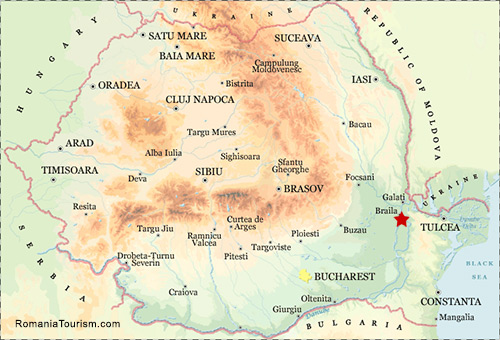
Settlement of Brăila, located on the banks of the Danube River,
appears in several Catalan portolan (nautical) charts around year 1325.
The 1350 Libro de conoscimiento (Spanish book of knowledge) the town
is mentioned as Drinago.
Greek documents refer to the town as Proilabum or Proilava.
The current name Brăila appears for the first time in an official document issued on January 20, 1368:
a trade treaty signed by the voivode of Wallachia, Vlaicu Vladislav.
The treaty confirms "the continuation of all the trading privileges"
for the merchands in Brasov, in southern Transylvania:
"All the goods that will take the road to Brăila, "per viam Braylam" (Latin) are exempt from customs duties.
From 1538–1540 until 1829 the town and its surroundings were controlled by the Ottoman Empire, who called it Ibraila.
The names Brillago and Brailov (Slavic) also appear in some old records.
During the Ottoman occupation, the Turks built a strong fortress with defensive walls,
which dominated the port and the river.
In 1836, Brăila was declared a Porto Franco (free port) and the city quickly became a land of promise, a new Little America. Investors and workers from all over Europe came to Braila and gave the city a cosmopolitan character. The town became one of the three most important ports on the Romanian section of the Danube River, together with Turnu Magurele and Giurgiu. Brăila was rebuilt during the mid-1800s, according to a modern urban plan that highlighted the, amphitheater-shaped, sloping terrain, descending towards the Danube. Therefore Braila is also known as the "fan-shaped city", due to its shape of a fan that the Danube opens towards the plains. Braila kept pace with the major urban centers of Western Europe: at the end of the 19th century Braila was a well-organized city with paved streets, telephone service (1883), sewerage and filtered water supply (1891), and modern means of transportation (electric tram - 1900).
Braila Sights and Landmarks
Braila still retains some of its 19th century grandeur when successful businessmen built elegant villas and mansions.
More than 2,000 old buildings, palaces, and mansions - built in the mid 1800s are still standing and - give the city a unique feel.
The largest concention of historic buildings - reminding of the cosmopolitan times of the mid 19th century
- is found on Strada (street) Mihail Eminescu (formerly Regala).
Unfortunately, many of these historic buildings are now in disrepair.
Brăila Old Town, is centered around Traian Square (Piața Traian).
All the main arteries of the city start from Traian square, in the shape of a arc/ semicircle
whose base is the Danube river, to the east.
Numerous historic buildings, with charming architecture, face Traian Square.
Best known Braila landmarks include:
Maria Filotti Theater (Teatrul Maria Filotti) -
a true architectural gem of Brăila and is probably the most beautiful and elegant, Baroc-style, theater in Romania.
It was originally a mixed-use building (hotel, theater, shops, restaurant, and café).
In 1895 significant renovations and additions to the building were made.
1n 1969, Braila Drama Theatre was re-named
after one of the most beloved Romanian actresses of the 20th century: Maria Filotti.
Born on October 4, 1883, near Braila, Filotti made her debut in 1905 and has played in over 150 plays.
She was also a teacher at the Conservatory of Dramatic Art and,
a member of the International Committee of the Universal Theater Society.
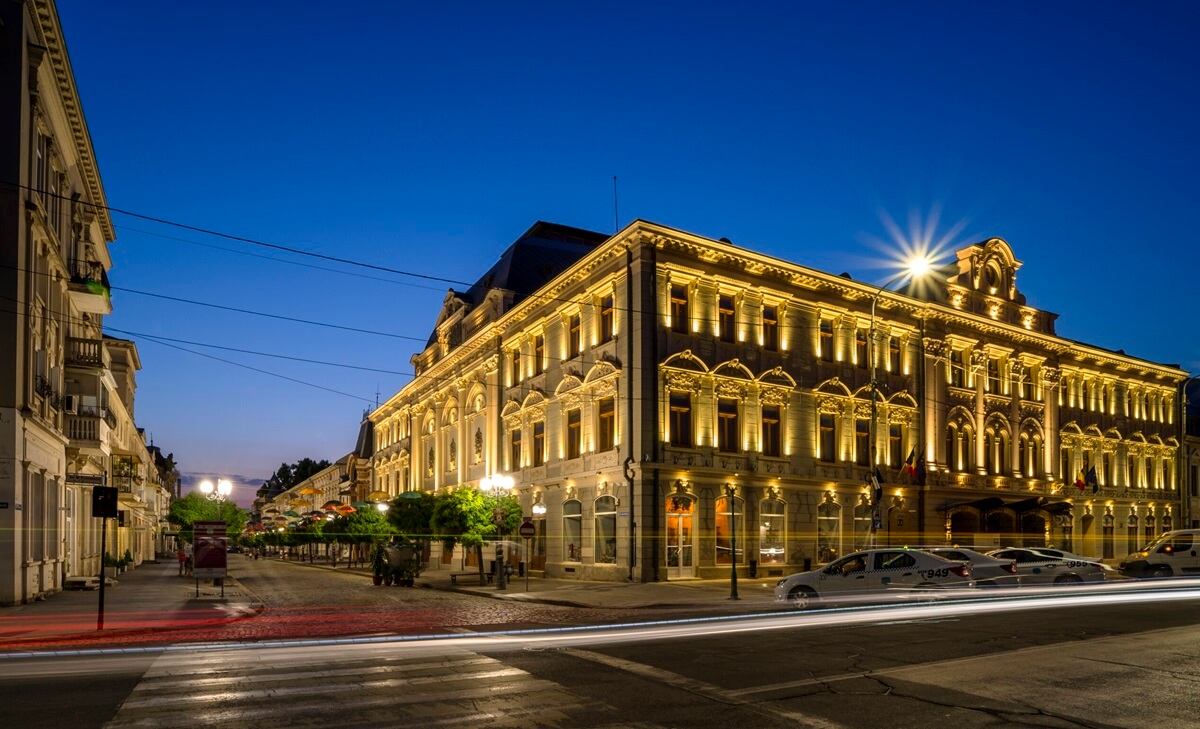
Lyra Palace (Braila Palace of Culture - Palatul Culturii Brailene) - constructed between 1924 and 1926, with funding provided by the city council, the prefecture, and several donors Lyra Palace attests to the love of music and education among the people of Braila, passed down from generation to generation.
The Traian Park clock (Ceasul Public) - a symbol of Braila since 1909. The 36-foot high clock is decorated with Baroque elements and, has four faces facing the main streets leading away from the square. One of the features features a sailing ship that also appears on the city's old seals.
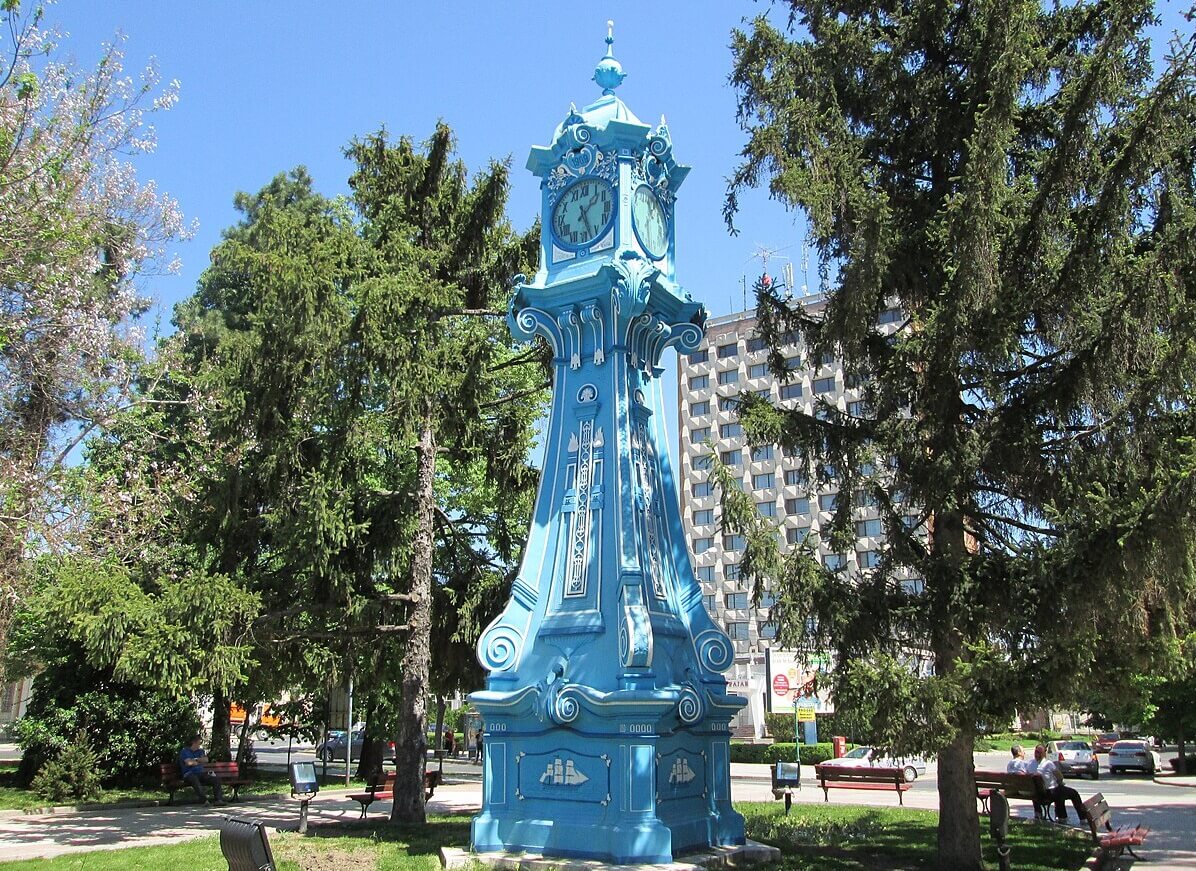
The Church of the Holy Archangels Michael and Gabriel. The structure was builtin the 17th century, during the Turkish ocupation of the city, to serve as a mosque. After Brăila was returned to the principate of Wallachia (southern Romania, the mosque was converted into an Orthodox church (1831). However, the oriental elements of the building have been well-preserved. It is the only church in Romania that originated as a mosque and one of the very few Romanian churches without towers.
Braila Water Tower (Castelul de Apă - Brăila) - built in 1912 - was, at the time of the ribbon-cutting ceremony the biggest water tower in Romania. It was decomissioned in 1950 and transformed in a storage facility. In 1980, the upper level of the tower became a revolving restaurant. Braila water tower - the highest observation point in the city - has been refurbished is now home to an astronomic observatory, mini movie theatre, exposition spaces and observation deck.
The Greek Church is a Byzantine style place or worship, with three altars, a round dome, and a cross-shaped plan with two towers. Its façade shows ancient Greek and Renaissance influences. Constructed between 1862 and 1872, with financial support from the Greek community in Braila, the church served the spiritual needs of the local community as well as those of the Greek sailors who landed in the ports Braila and Galati, at the mouth of the Danube river. The interior frescoes of this large church (150-foot long and 70-foot wide) were painted, in 1890, by Romanian artist Gheorghe Tătărescu. Other noteworthy features include: spectacular stained glass windows, the iconostasis decorated with gold leaf, the Murano crystal chandelier at the entrance to the church and the five other smaller chandeliers, made of Bohemian crystal.
Braila Boat Terminal (Gara Fluviala Braila) -
the city's former cruise terminal is an impressive two-story structure
(first floor: two waiting rooms, a ticket office, and restrooms,
the upper floor: harbor master's offices and, and the headquarters of the national naval authority.
It served as yacht of Romania's royal family until 1916 when it became a mobile maitenance/repair boat for warships on the Danube. During the interwar period, it served as a passenger ship and during World War II, it was used for as an army communications unit.
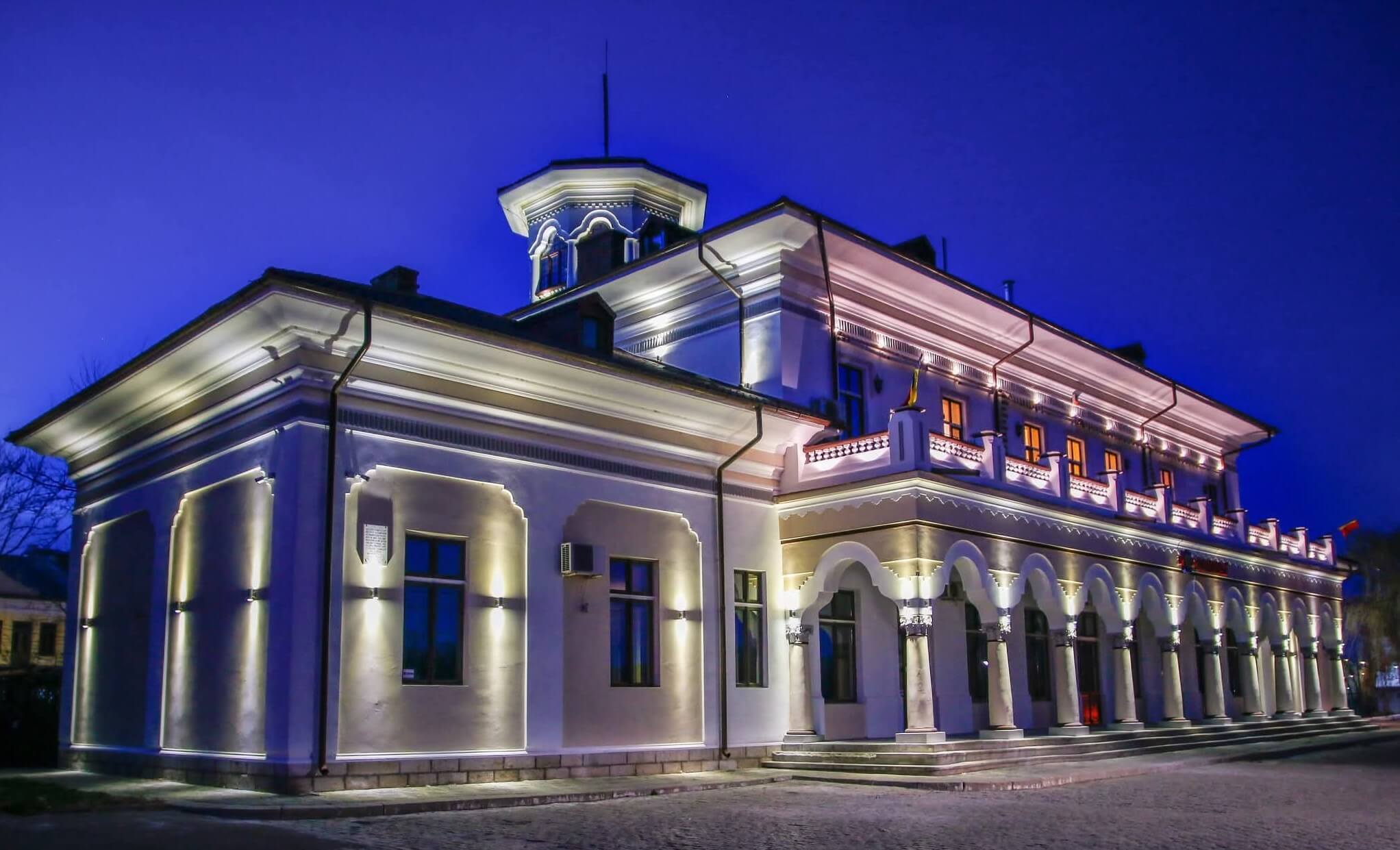
The Palace of Agriculture (Palatul Agriculturii) - an impressive neo-Romanian style building, completed in 1929, features architectural elements - characteristic of the Neo-Romanian style: a loggia with semicircular arches, a porch, decorative relief panels, tall chimneys, and a hipped roof, individualized for each wing of the building. The buiding has 122 rooms - office space and function/meeting halls.
Violattos Steam Mill (Moara Violattos)
At the end of the 19th century and beginning of the 20th century,
Romania was the world's third largest exporter of wheat, after Russia and the USA.
Along with wheat, large quantities of flour - produced by the seven steam mills in town -
were also exported through the port of Brăila.
When completed in 1896,
the Violattos Mill was considered the largest and most modern mill in southeastern Europe
(over 100 tons of flour were processed every day).
Several sources show that the building stands on 148 cedar pillars, brought from Libya (north Africa),
and covered with several layers of natural oils extracted from various resins and tar.
Violattos Mill was designed by prolific architect and engineer
Anghel Saligny.
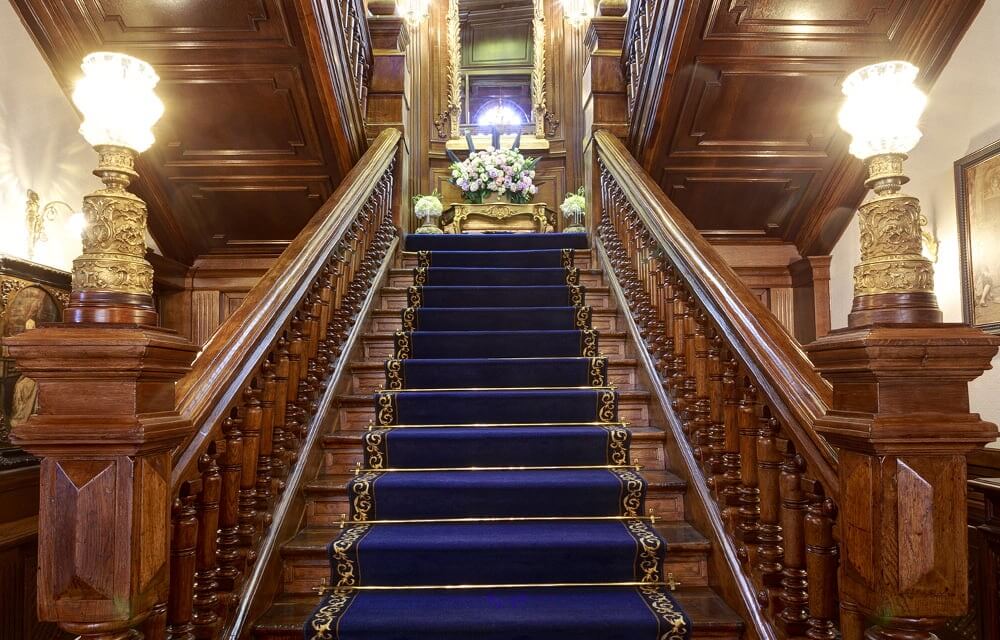
The Palm Trees House ("Casa cu Palmieri") - a two-story private residence, built in 1870, called by the locals "Casa cu Palmieri" (the Palm Trees House). In 1925, a new wing was added and, it became the headquarters of the Italian Bank. After 1950, it was transformed into a restaurant and, later, into a confiserie. The building has recently been thoroughly renovated and transformed into an elegant restaurant - Restaurantul Carol. The ground floor is now aa elegant, Neoclassical-style, event hall that features stucco columns and coffered ceiling, Murano glass chandeliers, Venetian mirrors, and rich tapestries. The main stained glass door, made of solid wood, is a replica of the original door. A spectacular stained-glass wall separates the building's lobby from the events hall. Access to the upper floor is via a monumental wood staircase, with a richly carved balustrade. In the middle of the staircase, there is a 'rest area' with two vintage armchairs framing a small, marble-top, table. Above the staircase, there is a stained-glass skylight. The upstairs rooms have panelled or wallpapered walls, antique furniture and are decorated with interwar period objects. The basement of the building, which was used as a vault during the time when the building served a a bank, now houses a wine cellar.
For a view of the nearby Macin Mountains, stroll through Braila's public park or the Danube River Promenade, a 5 miles walkway along River Danube.
Self-guided, Baila walking tour itinerary idea:
Start at Braila Tourist Info Centre – Musem of City of Braila “Carol I” -- Theatre "Maria Filotti" --
Strada Mihai Eminescu / Old Town Braila -- Faculty of Engineering and Agronomy --
Palace of Agriculture – Piata Independentei – Danube River Esplanade / Braila Boat Terminal --
Traian Square – Public Library “Panait Istrati” -- House of Music "Petre Stefanescu Goanga" --
“Nică Petre” Cultural Centre -- "Panait Istrati" Memorial House -- the Public Garden --
the Monument Park.
More Braila walking tour itinerary
info.
...
Braila Museums
Museum of Brăila County
Muzeul Brăilei “Carol I”
Address: Piata Traian 3
Telephone: (+4) 0339 401.002
Hours:
May – September: 10 a.m. – 6 p.m. Wed. – Sun.
October – April: 9 a.m. – 5 p.m. Wed. – Sun.
Admission charge
Located in the former French Hotel (Hotelul Francez), an elegant two-story building dating back to 1855,
the museum features an Archeology section (pieces from the Neolithic period, Bronze Age jewelry, as well as cult objects and Roman glass vessels)
a History section (furniture and traditional objects) an Art section, as well as an Ethnographic and Folk Art section.
No less important are its collections of old books, manuscripts and documents, numismatics, military history.
A rich collection of sepia photos provide an interesting foray into the history of Braila during the 19th and 20th centuries.
Natural Science Museum
Complexul Muzeal de Stiinte ale Naturii
Adresa: Aleea Parcului 15
Telephone: (+4) 0339 401.006
Museum of Arts Collection - Brăila
Centrul Cultural „Nicăpetre"
Address: Strada Belvedere 1
Telephone: (+4) 0339 401.005
Brăila Ethnography Museum
Muzeul de Etnografie si Artă Populară
Address: Strada Polonă 14
Telephone: (+4) 0339 730.311
Brăila Art Gallery
Galeriile de Arta Emilia Dumitrescu
Address: Strada I. L. Caragiale 3
Telephone: (+4) 0339 627.115
Writer Panait Istrati Memorial House
Casa Memorială Panait Istrati
Address: Grădina Publică Brăila
Telephone: (+4) 0339 401.004
...
Braila Performing Arts
Brăila Drama Theatre
Teatrul Dramatic "Maria Filotti"
Address: Strada Mihai Eminescu 2
Telephone: (+4) 0239 613.969
Brăila Philharmonic
Filarmonica "Lyra - George Cavadia", Braila
Address: Strada Ana Aslan 29
Telephone: (+4) 0239 615.010
Brăila Puppet Theatre "Carabus"
Teatrul de Păpuși Braila
Address: Strada General Eremia Grigorescu 57
Telephone: (+4) 0239 614.880
...
Attractions not far from Braila
Macin Winery
Crama Dobrogeana
Where: 18 miles east of Braila
Access: car, bus
Address: Str. Viticultori 2, town Macin
Telephone: (+4) 0240 573.368
Town of Macin is known for its wines obtained from native varieties of grapes Tămâioasă Românească, Fetească Neagră.
Macin Winery more info
Macin Mountains National Park
Parcul National Muntii Macinului
Where: 15 miles east of Braila
Access: car (on DN22 D)
400 million years ago, this mountain range stretched all the way to Western Europe.
Its traces can still be found in Bohemia and the French Central Massif. Today, Tutuiatu Peak,
the highest peak of the oldest mountain range in Romania, reaches just 1,495 ft.
Brăila Wetlands Nature Park
Parcul Natural Balta Mică a Brăilei
Where: 35 miles south of Brăila
Balta Mică a Brăilei info
Basilica Niculițel
Bazilica Niculițel
Where: 42 miles east of Braila
Access: car, bus
Address: DJ229C 43, Niculițel
A Christian basilica, built in the mid-3rd century near the village of Niculițel,
was revealed in 1971 when a creek overflowed its banks.
The relics of Saints Zoticus, Atallus, Camisius and Philippos,
who endured martyrdom because they openly proclaimed their faith in Christ, were found in Niculițel basilica
and can now be seen at
Cocoș Monastery,
5 miles northwest of Niculițel.
Basilica Niculițel more info
Crama Sarica - Niculitel
Where: 44 miles east of Braila
Access: car, bus
Address: DN 22 Tulcea - 4 miles east of village Niculitel
Telephone: (+4) 0744 551.518
E-mail
Sarica Niculițel Winery (Casa Niculitel) info
...
Day Trips from Braila
The Danube Delta
Delta Dunarii
Location: 50 miles east of Braila
Access: car or bus to Tulcea and then boat
The Danube Delta is comprised of an intricate network of waterways and lakes
divided between the three main estuary channels of the Danube.
The area of floating reed islands, forests, pastures and sand dunes covers 3,000 square miles and is home to a vast array of wildlife.
Located at the tip of the three channels, town of Tulcea makes a natural starting point for exploring the Delta.
Danube Delta more info
Location: 48 miles (80 km) east of Braila
Access: car, bus
Tulcea info
Crama Sarba Odobesti
Where: 68 miles northwest of Braila
Address: Strada Sarba 23, village Vărsătura - Jariştea
Telephone: (+4) 0722 243.331
Access: car, bus
Wines obtained at Sarba winery from native varieties of grapes include: Fetească Neagră, Fetească Regală and Șarbă.
Crama Sarba Odobesti more info
Location: 125 miles southeast of Braila
Access: car, bus
Constanta info
...
BRAILA TRIP PLANNING INFO
Transportation
AirThe nearest airports to Braila are:
Constanta (CND) - 102 miles south
Bacau (BCM) - 118 miles north
Bucharest Otopeni - Henri Coanda (OTP) - 125 miles southwest
...
Traveling to Braila by CarThe shortest route from Bucharest to Brăila is:
Bucharest – Drajna - Slobozia - Braila (A 2 -- E584)
Distance: 135 miles
Approximate travel time: 2 hours : 45 minutes
| Travel distances from/to Braila: | |
|---|---|
| City | Distance (miles) |
| Bucharest | 135 miles |
| Arad | 405 miles |
| Baia Mare | 350 miles |
| Brasov | 150 miles |
| Constanta | 125 miles |
| Iasi | 160 miles |
| Oradea | 410 miles |
| Satu Mare | 380 miles |
| Sibiu | 235 miles |
| Sighetu Marmatiei | 325 miles |
| Sighisoara | 220 miles |
| Suceava | 205 miles |
| Timisoara | 400 miles |
| Tulcea | 50 miles |
...
Reaching Braila by TrainBrăila Train Station
Gara Braila
Address: Strada General Eremia Grigorescu
Daily direct trains connect Braila with:
Bucharest (journey time: 3 ½ hours)
Buzau (journey time: 2 hours)
Constanta (journey time: 3 ½ hours)
Galati (journey time: 45 minutes)
Travel from Braila to Tulcea / Danube Delta is only possible by car / bus.
To check train and bus schedules please visit RomaniaTourism transportation section.
...
Inter-City BusBraila Inter-City Bus Station
Autogara Braila
Address: Strada Siret 10
Telephone: (+4) 0239 619.220
Daily domestic bus service from/to: Bucharest, Bacău, Barlad, Brasov, Constanta, Galati, Iasi, Macin, Mangalia, Sibiu, Suceava, Tulcea, Vama Veche
...
Braila Public Transportation5 tramway and 9 bus routes connect Braila's main areas and tourist attractions.
Braila public transportation map
...
Braila Taxi| Braila Taxi Companies | |
|---|---|
| Name | Phone # |
| Taxi As | (+4) 0726.666.068 |
| Taxi 949 Braila | (+4) 0767 112.999 |
| Taxi Dan | (+4) 0239 611.111 |
| Taxi Unvip | (+4) 0239 619.100 |
| Taxi Kamy | (+4) 0239 619.100 |
...
Braila Car RentalGreat car rental rates in Braila.
Promotor Rent a Car
Tel: (+4) 0734 403.403
...
Braila Hotels
Accommodations in Braila include:
| Hotel Name | Class | Location |
|---|---|---|
| Casa Popeea | boutique | Braila Old Town |
| Grand Hotel Orient | boutique | Braila City Centre |
| Hotel Saint Germain | four-star / upscale | Braila City Centre |
| Alma Health Spa Retreat | four-star / upscale | Lacu Sarat - 5 miles south of Braila |
| Belvedere | three-star / midscale | Danube River Walk (Faleza) |
| Traian | three-star / midscale | Braila City Centre |
...
Braila Tourist Information
Braila Tourist Info Centre
Centrul National de Informare (CNIPT) Braila
Address: Str. Edmond Nicolau 4 A
Telephone: (+4) 0786 478.494
E-mail
Braila City Hall - Tourist Information Department
Primăria Brăila
Address: Piata Independentei 1
Telephone: (+4) 0239 649.947
E-mail
...
Braila Health and Emergency
Pharmacies (farmacie) open non-stop in Braila:
Farmacia Dona
Address: Strada Școlilor 96
Telephone: (+4) 0372 401.252
Braila Hospitals
Braila Emergency Hospital
Spitalul Judetean de Urgenta Braila
Address: Soseaua Buzaului 2
Telephone: (+4) 0239 692.222
...
Braila Local Authorities
Braila County Archives
Directia Judeteana Braila a Arhivelor Nationale
Address: Str. Plevna 8 bis
Braila, postal code 810111
Telephone: (+4) 0239 613.147
Hours
E-mail
Braila City Hall
Primaria Braila
Address: Piata Independentei 1
Telephone: (+4) 0239 649.947
E-mail
Braila Consumer Protection Agency
Comisariatul Judeţean pentru Protecţia Consumatorilor Brăila
Address: Str. 1 Decembrie 1918 nr. 121
Telephone: (+4) 0239 615.641
E-mail
Postal services
Braila Main Post Office
Oficiul Postal Braila 1
Address: Str. Danubiului 8
Telephone: (+4) 0736 705 745
Telephoning Braila from Abroad
International Access Code + 4 (country code) + 0239 or 0339 (area code) + six-digit telephone number.
...
Braila Maps
Town of Braila interactive Street Map (Harta Interactiva Braila)
Braila City centre map ( Braila harta zonei centrale)
Romania Physical Map -- ( Romania - Harta Fizica)
Romania main roads and tourist attractions -- (Harta principalelor drumuri si atractii turistice)
Romania Main Roads map -- (Harta Drumurilor Nationale)
Romania Railway Map -- ( Romania, Harta Cailor Ferate)